02 / 08Search with Intuitiveness
01 / Work
Overview
Search with Intuitiveness
WeChat Search Function Redesign

Translating interview findings into clearer search entry points, file results linked to their source chats, and more direct search paths within conversations. The redesign clarifies search options, sorting controls and media actions to help people retrieve past content while preserving WeChat’s familiar interface patterns.
Context
Context
WeChat search supports message and media retrieval, yet many middle-aged and older users continue relying on manual scrolling.
Interviews suggested that the barrier was not feature availability, but recognition, navigation confidence, and understanding of search logic.
This project explored how search could become more discoverable while preserving existing interaction patterns.
Challenge
Challenge—
How might WeChat make search easier to recognise and use for middle-aged and older users without changing its familiar interface patterns?
Research
Research—
Research combined qualitative interviews and interface comparison to identify how users recognise, access, and retrieve information within WeChat.
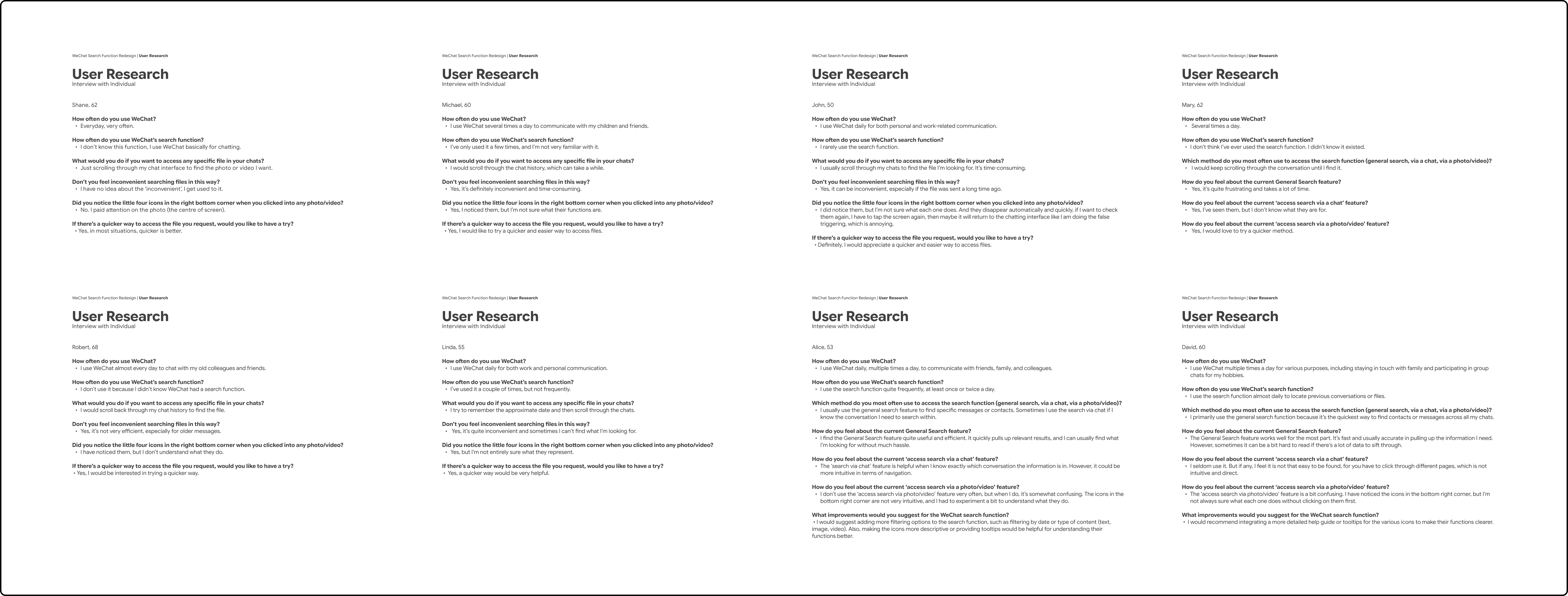
/01 User Interviews
User interviews were conducted with middle-aged and older WeChat users to understand how they currently find past messages, files, images, and links in everyday chat scenarios.
The interviews focused on where users usually start searching, when they choose to scroll manually, and what makes the existing search function difficult to recognise or use.
/02 Comparative Review
The comparison helped identify where WeChat’s search entry points, file categories, and media search paths were less direct or less clearly presented.


01 / 04
/03 Research Insights
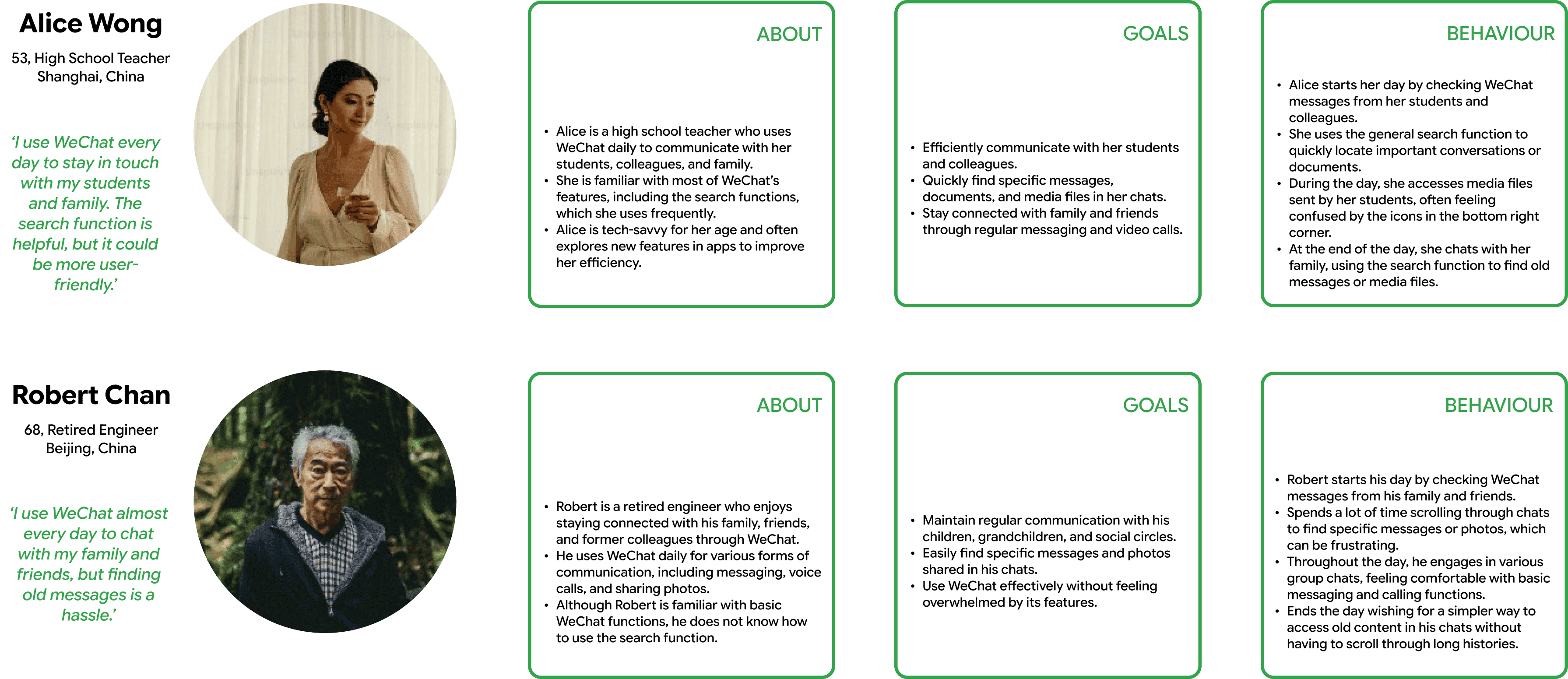
Findings from the interviews and interface comparison were summarised into key pain points and user needs. The main issues were low awareness of the search function, long manual scrolling through chat histories, unclear icon meanings, and limited filtering options for locating specific files or media.

User Persona
User Persona—
User Flow
User Flow—

Multiple Search Entry Paths
Users can access search either from the main Chats interface or from within a specific conversation, depending on whether they are searching broadly or retrieving content from a known chat context.Clearer File-Type Filtering
Search categories are surfaced more explicitly during the retrieval process, allowing users to narrow results by file type without navigating through multiple hidden layers.Media-Based Search Entry
Search actions can also be triggered directly from media content inside a chat, reducing unnecessary navigation and making retrieval behaviour more context-aware.
Lo-Fi Wireframe
Lo-Fi Wireframe—

Key Features
Key Features—
No.1
Optimised Guidance for the Search Bar and Search Options of General Search
With the new description in the search bar and the reordered options for searching, all is clear at a glance.
No.2
New List Design for the Results of the General Search
It lists all the files with their associated chat avatar displayed at the bottom of each file and adds a new sorting menu, making the process of finding a file more convenient and intuitive.
No.3
Finding files in a Chat is More Easily Accessible
A new expanded option menu for file types is offered with simplicity, just one click to your files in a chat!
No.4
New Descriptive Buttons for Media Search in a Chat
The buttons that appear when clicking on any media file have been redesigned from material to descriptive, balancing clarity with simplicity.
Prototype
Prototypes—
General Search - Media
General Search - Contacts
In Chat - Pic & Vid
In Chat - Document
In Chat - Links
In Chat - Mini Programs
In Chat - Channel
In Chat - Music & Audio
In Chat - Transaction
In Chat - Search All Files