Projects
Projects
Writing Samples
Writing Samples
Info
Info

Wastend
Structuring fragmented disposal guidance into clear, item-level guidance.
Date:
2026
Role:
Sole product designer and developer
Primary context:
Hong Kong, with comparative research across selected jurisdictions
Status:
Product validation and launch planning
Wastend
Know exactly where your waste belongs.
Date: 2026
Role: Sole product designer and developer
Scope: Hong Kong, with comparative research across selected jurisdictions
Status: Product validation and launch planning
Wastend
Structuring fragmented disposal guidance into clear, item-level guidance.
Date:
2026
Role:
Sole product designer and developer
Primary context:
Hong Kong, with comparative research across selected jurisdictions
Status:
Product validation and launch planning

Challenge
> Waste guidance is commonly organised around materials, collection programmes or authorities. Users, however, begin with a specific item and need a clear answer that applies to their location.
Approach
> Wastend uses a structured rule model to connect items with local classifications, preparation requirements, exceptions and source evidence, then turns that structure into an item-first mobile experience.
Current State
> The information architecture, interface and core user flows are complete and launch-ready. Current work focuses on validating, expanding and integrating the source-backed local rule database across supported jurisdictions.
Challenge
> Waste guidance is commonly organised around materials, collection programmes or authorities. Users, however, begin with a specific item and need a clear answer that applies to their location.
Approach
> Wastend uses a structured rule model to connect items with local classifications, preparation requirements, exceptions and source evidence, then turns that structure into an item-first mobile experience.
Current State
> The information architecture, interface and core user flows are complete and launch-ready. Current work focuses on validating, expanding and integrating the source-backed local rule database across supported jurisdictions.
WHY THE PROBLEM EXISTS
Same items, different rules.
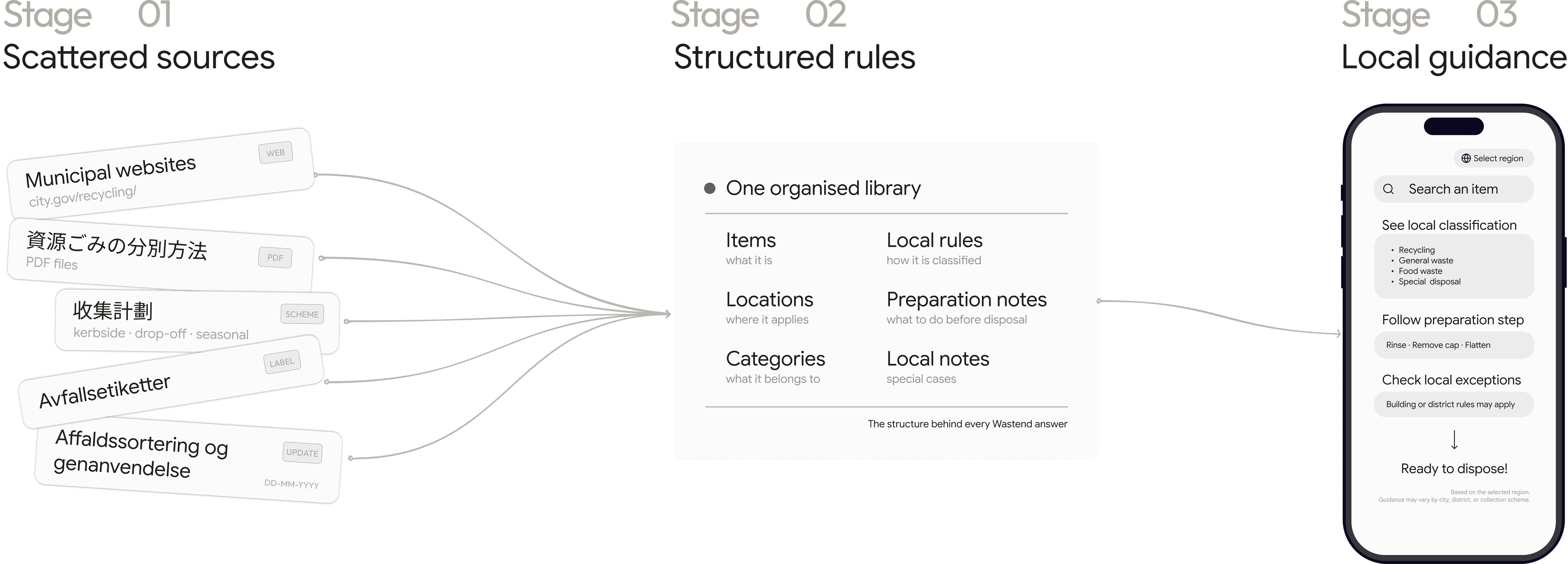
Local disposal information is distributed across municipal websites, PDFs, collection schemes and facility pages. More importantly, these rules are jurisdiction-specific: a classification, preparation requirement or disposal route that is correct in one place cannot be assumed to apply elsewhere. People begin with the item they are holding, not the administrative system behind it, creating a need for source-backed guidance that preserves local differences while making the next step easier to understand.
WHY THE PROBLEM EXISTS
Same items, different rules.
Local disposal information is distributed across municipal websites, PDFs, collection schemes and facility pages. More importantly, these rules are jurisdiction-specific: a classification, preparation requirement or disposal route that is correct in one place cannot be assumed to apply elsewhere. People begin with the item they are holding, not the administrative system behind it, creating a need for source-backed guidance that preserves local differences while making the next step easier to understand.
WHY THE PROBLEM EXISTS
Same items, different rules.
Local disposal information is distributed across municipal websites, PDFs, collection schemes and facility pages. More importantly, these rules are jurisdiction-specific: a classification, preparation requirement or disposal route that is correct in one place cannot be assumed to apply elsewhere. People begin with the item they are holding, not the administrative system behind it, creating a need for source-backed guidance that preserves local differences while making the next step easier to understand.


Environmental Protection Department. (n.d.). Product Eco-responsibility Ordinance (Cap. 603). Hong Kong SAR. https://www.elegislation.gov.hk/hk/cap603
Environmental Protection Department. (n.d.). Waste Disposal Ordinance (Cap. 354). Hong Kong SAR. https://www.elegislation.gov.hk/hk/cap354
Environmental Protection Department. (n.d.). Enhanced Plastic Shopping Bag Charging Scheme. Hong Kong SAR. https://www.epd.gov.hk/epd/english/environmentinhk/waste/pro_responsibility/psb_the_charge.html
Ministry of Justice, Japan (Japanese Law Translation). (1970). Act on Waste Management and Public Cleaning (Act No. 137 of 1970). Japan. https://www.japaneselawtranslation.go.jp/en/laws/download/4529/09/s45Aa001370204en16.0_r4A68.pdf
Ministry of Justice, Japan (Japanese Law Translation). (1995). Act on the Promotion of Sorted Collection and Recycling of Containers and Packaging (Act No. 112 of 1995). Japan. https://www.japaneselawtranslation.go.jp/en/laws/download/3828/09/h07Aa001120201en14.0_h18A76.pdf
Ministry of Justice, Japan (Japanese Law Translation). (2000). Basic Act on Establishing a Sound Material-Cycle Society (Act No. 110 of 2000). Japan. https://www.japaneselawtranslation.go.jp/en/laws/download/3799/09/h12Aa001100501en14.0.pdf
Ministry of the Environment, Japan. (2022). Act on Promoting Resource Circulation for Plastics. Japan. https://plastic-circulation.env.go.jp/
Korea Legislation Research Institute. (n.d.). Wastes Control Act. Republic of Korea. https://elaw.klri.re.kr/eng_service/lawViewContent.do?hseq=46237
Korea Legislation Research Institute. (n.d.). Act on the Promotion of Saving and Recycling of Resources. Republic of Korea. https://elaw.klri.re.kr/eng_mobile/viewer.do?hseq=62551&type=part&key=39
Urban SDG Knowledge Platform. (n.d.). Volume Based Waste Fee (VBWF) System. Seoul, Republic of Korea. https://www.urbansdgplatform.org/profile/profile_caseView_detail.msc?from=list&no_case=669
The Danish Environmental Protection Agency. (n.d.). Extended Producer Responsibility. Denmark. https://eng.mst.dk/industry/waste/extended-producer-responsibility
Dansk Producentansvar. (n.d.). Packaging (producer responsibility). Denmark. https://producentansvar.dk/en/products-and-responsibility/packaging/
Vejle Municipality. (n.d.). Sorting instructions (en). Vejle, Denmark. https://www.vejle.dk/en/welcome-to-vejle/getting-started-in-vejle/waste-sorting/sorting-instructions-en/
City of Copenhagen. (n.d.). Recycling in Copenhagen. Copenhagen, Denmark. https://international.kk.dk/live/housing/recycling-in-copenhagen
Chambers and Partners. (2025). Environmental Law 2025: Denmark – Trends and Developments. Global Practice Guides. https://practiceguides.chambers.com/practice-guides/environmental-law-2025/denmark/trends-and-developments/O23197
Swedish Environmental Protection Agency (Naturvårdsverket). (n.d.). Producer responsibility for packaging. Sweden. https://www.naturvardsverket.se/en/guidance/extended-producer-responsibility-epr/producer-responsibility-for-packaging/
Government Offices of Sweden. (2000). The Swedish Environmental Code (Ds 2000:61). Sweden. https://www.government.se/legal-documents/2000/08/ds-200061/
Reference
HOW WASTEND WORKS
From scattered sources to structured guidance.
Wastend brings source-backed rules into a consistent structure of items, local classifications, applicable locations, preparation requirements and exceptions. This supports clearer user-facing guidance without erasing jurisdiction-specific terminology.
HOW WASTEND WORKS
From scattered sources to structured guidance.
Wastend brings source-backed rules into a consistent structure of items, local classifications, applicable locations, preparation requirements and exceptions. This supports clearer user-facing guidance without erasing jurisdiction-specific terminology.


HOW THE EXPERIENCE IS ORGANISED
Organising the product around the disposal decision.
Wastend uses a shared item-guidance structure across Guide, Compare and Saved. Global controls establish the regional context, while local classifications, conditions and source evidence remain jurisdiction-specific.
HOW THE EXPERIENCE IS ORGANISED
Organising the product around the disposal decision.
Wastend uses a shared item-guidance structure across Guide, Compare and Saved. Global controls establish the regional context, while local classifications, conditions and source evidence remain jurisdiction-specific.
INFORMATION STRUCTURE
INFORMATION ARCHITECTURE

CORE USER FLOW
CORE USER FLOW

SYSTEM DESIGN
SYSTEM DESIGN
01
/
System challenge
Local guidance varies by jurisdiction, source, material and disposal route. The system therefore needed to remain coherent as new rules and regions were added.
01
/
System challenge
Local guidance varies by jurisdiction, source, material and disposal route.
The system therefore needed to remain coherent as new rules and regions were added.
01
/
System challenge
Local guidance varies by jurisdiction, source, material and disposal route. The system therefore needed to remain coherent as new rules and regions were added.
02
/
System model
Local rules
→ Fixed taxonomy
→ Search and category routing
→ Shared detail-page structure
→ User guidance
Local rules
→ Fixed taxonomy
→ Search and category routing
→ Shared detail-page structure
→ User guidance
02
/
System model
Local rules
→ Fixed taxonomy
→ Search and category routing
→ Shared detail-page structure
→ User guidance
Local rules
→ Fixed taxonomy
→ Search and category routing
→ Shared detail-page structure
→ User guidance
03
/
Key system decisions
Fixed taxonomy across regions
Search integrated into Guide
Shared detail-page hierarchy
Fixed taxonomy across regions
Search integrated into Guide
Shared detail-page hierarchy
03
/
Key system decisions
Fixed taxonomy across regions
Search integrated into Guide
Shared detail-page hierarchy
Fixed taxonomy across regions
Search integrated into Guide
Shared detail-page hierarchy
WHAT USERS GET
From uncertainty to action.
Instead of asking users to interpret policy documents, Wastend presents the local classification, preparation steps, exclusions and source references relevant to the selected item and region.
WHAT USERS GET
From uncertainty to action.
Instead of asking users to interpret policy documents, Wastend presents the local classification, preparation steps, exclusions and source references relevant to the selected item and region.
Guide Tab
Search for everyday items or browse local waste categories to find region-specific disposal guidance.


Compare Tab
Compare how the same item is classified and handled across different regions, including local category and preparation differences.
Compare Tab
Compare how the same item is classified and handled across different regions, including local category and preparation differences.


Saved Tab
Keep frequently checked guidance in one place, with clear disposal instructions and the relevant region context.
Saved Tab
Keep frequently checked guidance in one place, with clear disposal instructions and the relevant region context.
Guide Tab
Search for everyday items or browse local waste categories to find region-specific disposal guidance.

Compare Tab
Compare how the same item is classified and handled across different regions, including local category and preparation differences.

Saved Tab
Keep frequently checked guidance in one place, with clear disposal instructions and the relevant region context.
VISUAL SYSTEM
A flexible identity for a rule-heavy product.
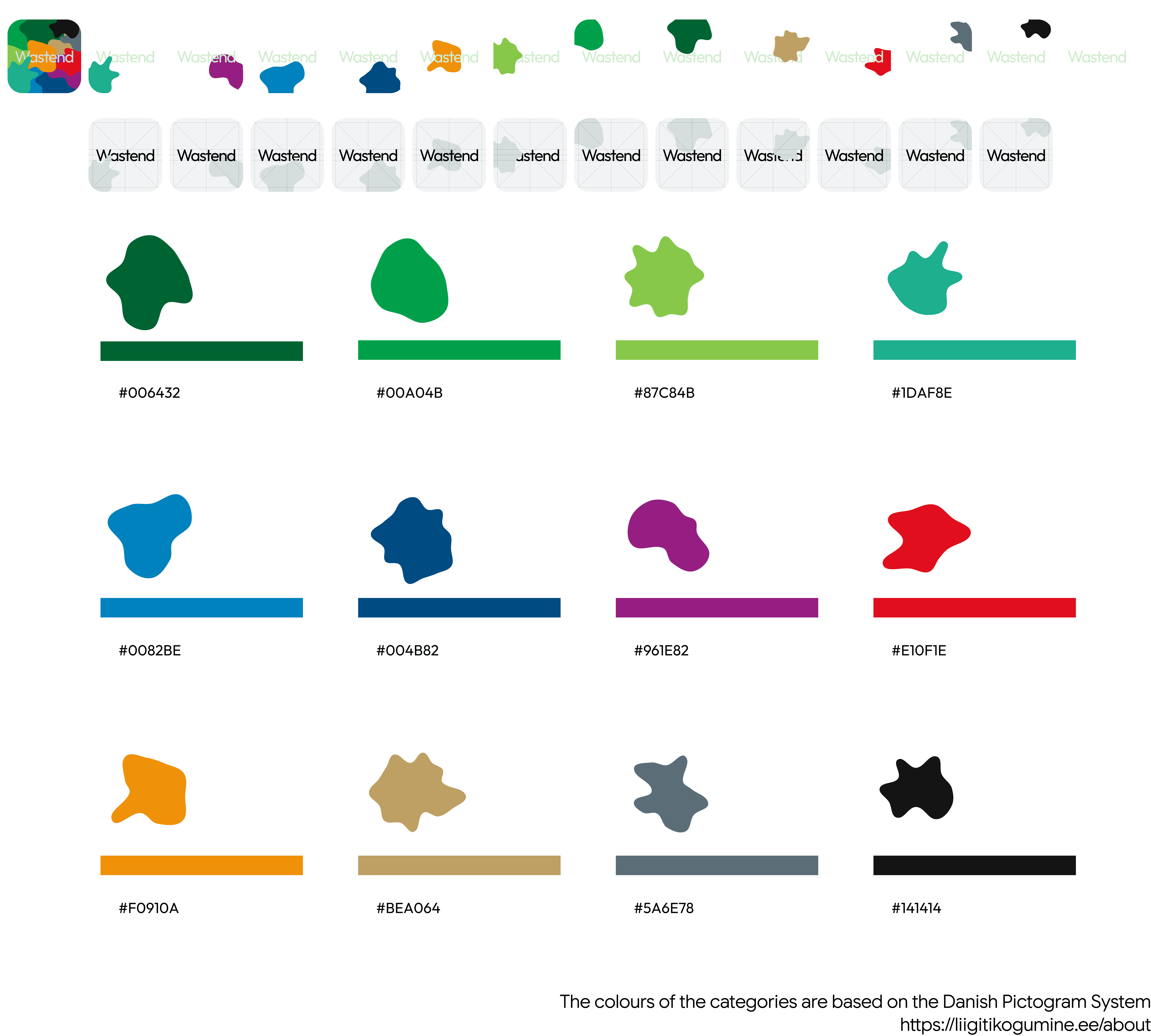
Irregular forms reflected variation across local rules, while neutral surfaces, clear hierarchy and category labels kept dense guidance readable. Colour supported recognition, but was not intended to carry meaning on its own.
VISUAL IDENTITY
The system that holds it together.
Supporting documentation for the brand and interface — the logo, colour, category coding, type, and icon language that keep guidance legible across the product.
PRODUCT STRATEGY
Expanding verified local data for launch.
The interface and core user flows are complete. Current work focuses on validating source-backed guidance, closing jurisdiction-specific coverage gaps and preparing the data layer for release.
PRODUCT STRATEGY
Expanding verified local data for launch.
The interface and core user flows are complete. Current work focuses on validating source-backed guidance, closing jurisdiction-specific coverage gaps and preparing the data layer for release.
01
Strengthen verified coverage
Strengthen
verified coverage
Prioritise high-value items and jurisdictions where guidance can be supported by clear, traceable public sources. Coverage expands through evidence quality rather than volume alone.
NEXT-STAGE OUTPUT
NEXT-STAGE OUTPUT
A focused, source-backed Hong Kong guidance set.
02
Validate the core journey
Validate the
core journey
Evaluate how users search for items, interpret conditional guidance and move from uncertainty to a practical next action. Findings would guide further interaction refinement.
NEXT-STAGE OUTPUT
NEXT-STAGE OUTPUT
Evidence on comprehension, task completion and repeat use.
03
Build repeatable data operations
Build repeatable
data operations
Refine the source-review, normalisation and update workflow so that guidance can grow while preserving consistency, provenance and clear handling of exceptions.
NEXT-STAGE OUTPUT
NEXT-STAGE OUTPUT
A documented and scalable update workflow.
FOCUSED LAUNCH DIRECTION
Start narrow,
learn from real use,
then expand with evidence.
Start narrow,
learn from
real use,
then expand
with evidence.
A focused Hong Kong release would provide the clearest basis for assessing the product experience and refining the data workflow before broader regional expansion.
01
Strengthen verified coverage
Prioritise high-value items and jurisdictions where guidance can be supported by clear, traceable public sources. Coverage expands through evidence quality rather than volume alone.
NEXT-STAGE OUTPUT
A focused, source-backed Hong Kong guidance set.
02
Validate the core journey
Evaluate how users search for items, interpret conditional guidance and move from uncertainty to a practical next action. Findings would guide further interaction refinement.
NEXT-STAGE OUTPUT
Evidence on comprehension, task completion and repeat use.
03
Build repeatable data operations
Refine the source-review, normalisation and update workflow so that guidance can grow while preserving consistency, provenance and clear handling of exceptions.
NEXT-STAGE OUTPUT
A documented and scalable update workflow.
FOCUSED LAUNCH DIRECTION
Start narrow,
learn from real use,
then expand with evidence.
A focused Hong Kong release would provide the clearest basis for assessing the product experience and refining the data workflow before broader regional expansion.

Up Next-
Search with Intuitiveness
WeChat Redesign