Projects
Projects
Writing Samples
Writing Samples
Info
Info

Date: Mar - Apr 2026
Duration: 2 weeks
Status/Venue: Unrealised Proposal · L0 Gallery, Jockey Club Creative Arts Centre
Team/Role: Group (6 Members) · Lead Curator, Research Lead, and Exhibition Narrative Designer
Key Contributions:
· Curatorial concept
· Research framework
· Narrative structure
· Method development
· Floor plan logic
· Presentation writing
· Final Deck Review (Style + Consistency)
Date: Mar - Apr 2026
Duration: 2 weeks
Status/Venue: Unrealised Proposal · L0 Gallery, Jockey Club Creative Arts Centre
Team/Role: Group (6 Members) · Lead Curator, Research Lead, and Exhibition Narrative Designer
Key Contributions:
· Curatorial concept
· Research framework
· Narrative structure
· Method development
· Floor plan logic
· Presentation writing
· Final Deck Review (Style + Consistency)
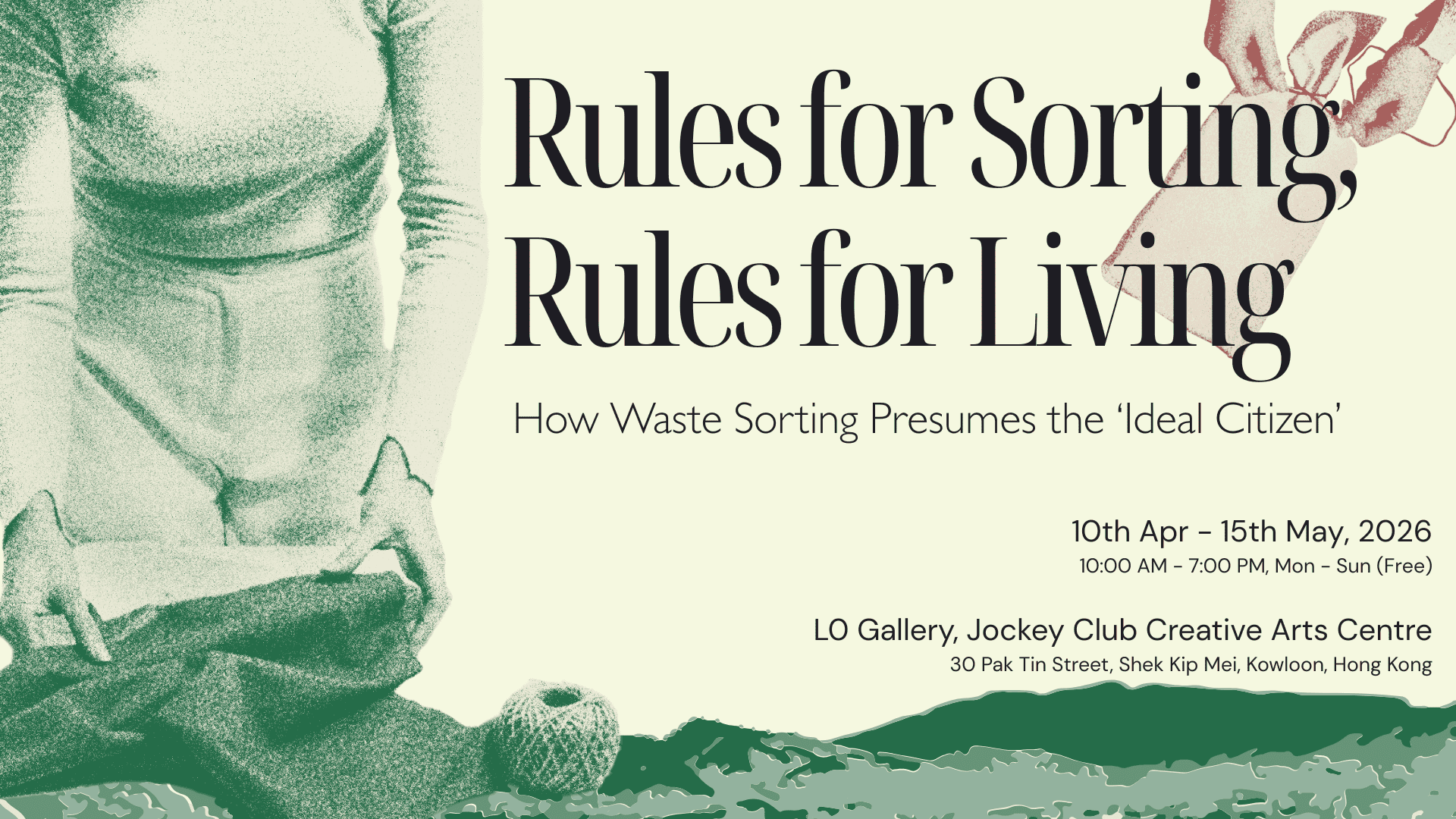
Rules for Sorting, Rules for Living examines how waste sorting turns from a practical act into a system of judgment.
Through participatory classification, documentary material, and selected artworks, the exhibition traces how local rules shape behaviour, moral pressure, and responsibility. It begins with a simple uncertainty: where should this object go? Yet this uncertainty soon reveals a larger structure that presumes an ‘ideal citizen’ who knows, complies, and takes responsibility.
The exhibition asks what happens when rules for sorting waste become rules for sorting people, and when environmental responsibility is made to stop at the individual.
Rules for Sorting, Rules for Living examines how waste sorting turns from a practical act into a system of judgment.
Through participatory classification, documentary material, and selected artworks, the exhibition traces how local rules shape behaviour, moral pressure, and responsibility. It begins with a simple uncertainty: where should this object go? Yet this uncertainty soon reveals a larger structure that presumes an ‘ideal citizen’ who knows, complies, and takes responsibility.
The exhibition asks what happens when rules for sorting waste become rules for sorting people, and when environmental responsibility is made to stop at the individual.
01/ Problem Framing
When Sorting Waste Becomes Sorting People
01/ Problem Framing
When Sorting Waste Becomes Sorting People
Why does a practical task
feel like a moral test?
Correct sorting is treated as civic responsibility
Mistakes become socially and emotionally charged
The system presumes an ‘ideal citizen’
Waste sorting is often framed as a matter of information: if people know the rule, they can act properly. This project starts elsewhere. It asks why sorting can produce hesitation, self-consciousness, and the feeling of being judged. Not a sorting aid, but a critique of the system that shapes the sorter.
Why does a practical task
feel like a moral test?
Correct sorting is treated as civic responsibility
Mistakes become socially and emotionally charged
The system presumes an ‘ideal citizen’
Waste sorting is often framed as a matter of information: if people know the rule, they can act properly. This project starts elsewhere. It asks why sorting can produce hesitation, self-consciousness, and the feeling of being judged. Not a sorting aid, but a critique of the system that shapes the sorter.
02/ Research & Method
Research Lens
What the literature helped us see
Classification creates order and error
Governance works through self-regulation
Waste responsibility is unevenly distributed
Curatorial Method
How we made it visible
Borrow the new resident’s perspective
Treat unfamiliarity as a reset position
Reopen local rules through comparison
Research & Method
Research Lens
What the literature helped us see
Classification creates order and error
Governance works through self-monitoring
Waste responsibility is unevenly distributed
Curatorial Method
How we made it visible
Borrow the new resident’s perspective
Treat unfamiliarity as a reset position
Reopen local rules to comparison
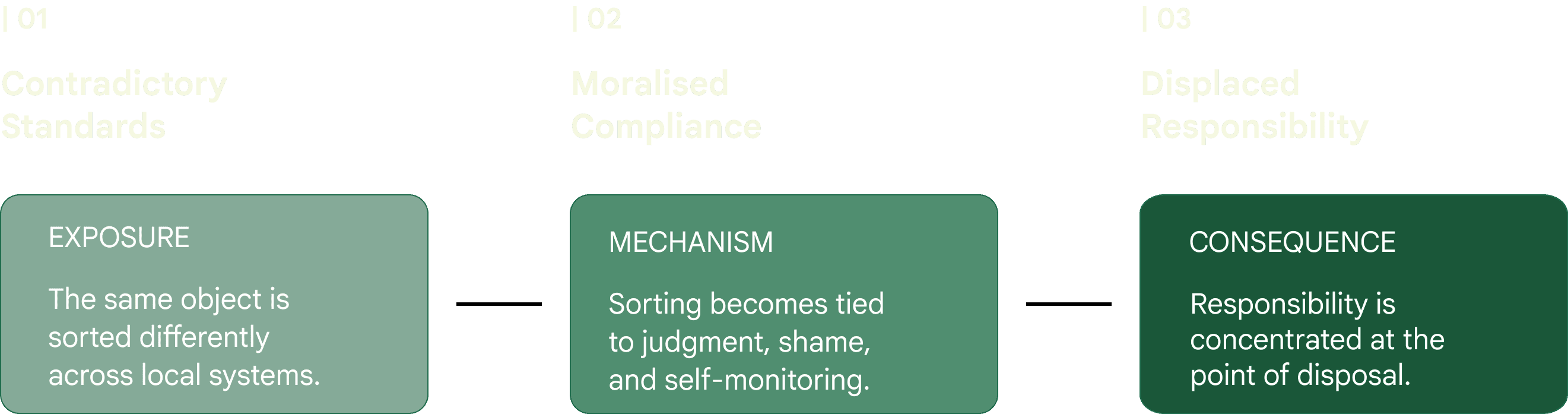
From these lenses, unfamiliarity became our curatorial tool.
03/ Curatorial Framework
Curatorial Framework
04/ Participatory Mechanism


Participatory Mechanism
05/ Spatial Sequence
The floor plan translates the exhibition argument into a visitor route: from exposure, to mechanism, to consequence.
The floor plan translates the exhibition argument into a visitor route:
from exposure, to mechanism, to consequence.
The floor plan translates the exhibition argument into a visitor route: from exposure, to mechanism, to consequence.

Section 1 / Exposure
01 + Archive Wall + 02
Visitors first classify, record their uncertainty, and then encounter the new resident’s perspective.
Section 2 / Mechanism
03–05
The route moves into works that examine scrutiny, judgment, and the moral pressure of compliance.
Section 3 / Consequence
06–09
The final section expands the frame beyond the bin, towards waste’s afterlife, labour, production, and packaging.
Section 1 / Exposure
01 + Archive Wall + 02
Visitors first classify, record their uncertainty, and then encounter the new resident’s perspective.
Section 2 / Mechanism
03–05
The route moves into works that examine scrutiny, judgment, and the moral pressure of compliance.
Section 3 / Consequence
06–09
The final section expands the frame beyond the bin, towards waste’s afterlife, labour, production, and packaging.
Spatial Sequence
06 / Outcome
06 / Outcome
Research Translation
Synthesised policy comparison and literature review
Turned theory into a three-part curatorial framework
Connected waste sorting to governance and responsibility
Curatorial Structuring
Built a sequence from exposure to consequence
Designed section logic and visitor movement
Used the floor plan as a form of argument
Participatory Thinking
Designed uncertainty before instruction
Turned private hesitation into public reflection
Framed participation as critique rather than education
Research Translation
Synthesised policy comparison and literature review
Turned theory into a three-part curatorial framework
Connected waste sorting to governance and responsibility
Curatorial Structuring
Built a sequence from exposure to consequence
Designed section logic and visitor movement
Used the floor plan as a form of argument
Participatory Thinking
Designed uncertainty before instruction
Turned private hesitation into public reflection
Framed participation as critique rather than education
Outcome
Up Next-
Breathing Paper